The best yoga apps for ADHD women are short, flexible, and easy to start, and 7 of them are compared below. One student took a yoga class for credit and could not sit still, close her eyes, or follow the guided breathing, even on medication. That is a common start, not a verdict on your brain. This guide sorts the apps by price, class length, and the effort it takes to press play.

Pick a yoga app by how few steps it takes to begin, not by how many classes it holds. For most women that means a free YouTube channel first, then Down Dog if you want sessions built for you. Skip any app that asks for a full hour before the practice counts.

Save this for later
You will want this again. Pin it to your planning board so it is one tap away when you need it.
Pin it for laterWhy Do Most Yoga Apps Fail an ADHD Brain?
Most yoga apps fail because they open with the parts ADHD makes hardest: sitting still, closing your eyes, and following slow breathing. The student above said she felt out of place for exactly those reasons. Her brain was playing 10 different songs, 4 different lyrics, 5 random noises, and 50 thoughts at once, while her fingers rubbed together and her feet swayed.
Is that a lack of effort? Nothing in her account says so. It is a mismatch between a format built for quiet minds and a brain that runs several channels at once. A good app lowers the demand: shorter classes, more movement, and a voice that keeps you company.
Does Yoga Actually Help ADHD?
Yoga helps a little, and mostly with one thing: impulsivity tied to time. A randomized trial of 82 adults with ADHD and 77 healthy controls compared 12 minutes of beginner Hatha yoga, made of 2 minutes of introduction plus 10 minutes of floor based poses with guided breathing, against 12 minutes of cycling. The authors found that exercise improved temporal impulsivity in adults with ADHD, and that yoga did so only for the ADHD group. They found no effect on attention, cognitive impulsivity, or movement.
That was one short session, so read it as a reason to try 10 minutes, not as a treatment. Not every mindfulness format shows an effect either. A 20 week program that combined cognitive behavioral therapy and mixed martial arts, tested on 14 teenage boys against 14 on a waitlist, improved conduct problems but not core ADHD symptoms. The National Institute of Mental Health lists medication and psychotherapy as the main ADHD treatments in adults, so treat yoga as a support for your nervous system, not a replacement for care.
Is a calmer body worth 10 minutes a day anyway? Many women say yes. For the wider toolkit, read how to regulate your ADHD nervous system and gentle movement ideas for ADHD women.
What Should You Look for in a Yoga App With ADHD?
Look for five things: steps to start, class length, voice, price, and a free trial. Each one decides whether you open the app on a tired Tuesday.
- Steps to start: two taps is good, and five is a wall. Fewer decisions means more mornings on the mat.
- Class length: 5 to 15 minutes is the sweet spot. Anything that needs 60 minutes will wait for a day that never comes.
- Voice: some brains need a teacher who talks the whole way through, and others need near silence. Test both.
- Price: free to $130 a year. A cheap app you open beats an expensive one you do not.
- Free trial: 7 days is common, so use all 7 before you judge.
Which Yoga App Builds the Session for You?
Down Dog builds the session for you, which removes the decision that stalls most ADHD mornings. Why does that matter? The first choice is usually the one that kills the habit. One commenter swears by it. When she is in the mood for yoga the flow is app, style of yoga, anything to target, length, go. She says it works because there are so few barriers to getting started, and she can favourite single moves or whole routines, with a visual guide and a voice over talking her through.
You choose the style, level, length, music, and teacher voice, and the app generates a fresh practice. Styles include Vinyasa, Hatha, Gentle, Restorative, and Yin. One subscription also opens Down Dog’s HIIT, Barre, Pilates, prenatal yoga, and meditation apps, plus a 7 minute workout for days when time is short.
The commenter cited $99 a year. Current listings are $9.99 a month or $59.99 a year in app stores, and typically $7.99 a month or $39.99 a year when you subscribe on the website. Prices shift, so check both before you pay.
Is Yoga With Adriene Enough, or Do You Need the Paid App?
The free YouTube channel is enough for most women, and the paid app adds a bigger library. Yoga With Adriene costs $0 on YouTube. The Find What Feels Good app costs $12.99 a month or $129.99 a year, with a 7 day free trial, and adds ad free streaming, meditations, and more classes.
One woman started after a friend described it as a girl and her dog on YouTube. She picked a video that same night at bedtime and has now done it every day for nearly 4 years. She says she had never managed anything consistently for a week, but tying it to bedtime worked, and 5 to 20 minutes a day has gradually changed her body.
Another woman hit the limit of the format. She loves the idea of morning yoga but wants videos that skip the gratitude and the setting of intentions. She does not want 90 full seconds of silence, she wants to do a sun salutation correctly, and she keeps hitting the +10s button. She joked that it is not Adriene, it is her, and Adriene a little. Does one channel suit everyone? No, so sample a few teachers before you commit to a paid library.
Which Apps Give You a Big Library of Classes?
Alo Moves, Peloton, Glo, and Insight Timer give you a big library, and each one costs more effort to choose from. A library is a pleasure for some brains and a stall for others, since 400 classes is 400 decisions.
- Alo Moves: $12.99 a month or $129.99 a year, with structured yoga programs for beginners.
- Peloton App One: about $16 a month, with yoga flows from 5 to 75 minutes and 5 minute tutorials on basic poses. It includes strength, meditation, and floor workouts too.
- Glo: $30 a month or $245 a year with a 7 day free trial, and a full catalog of yoga, Pilates, and meditation.
- Insight Timer: free, with live yoga classes and more than 250,000 guided meditations. Member Plus costs $9.99 a month or $59.99 a year.
Best Yoga Apps for ADHD at a Glance: Which Ones Win?
The table lines up all 7 picks by the job each one does. Prices are current United States listings from retailer and app pages, and they shift with sales and plans.
| Product | Best For | Price Range | My Take |
|---|---|---|---|
| Down Dog | A session built for you in 5 taps | $39.99 to $59.99 a year | Fewest barriers of the group. Pick length first, then go. |
| Yoga With Adriene (YouTube) | A free start and a friendly voice | Free | Try first. If the chatter grates, move on without guilt. |
| Find What Feels Good | Adriene fans who want ad free classes | $12.99 a month, $129.99 a year | Pay only after the free channel has become a habit. |
| Alo Moves | Structured programs and variety | $12.99 a month, $129.99 a year | Good library, so decide your 3 favorite classes up front. |
| Peloton App One | Short flows from 5 minutes | About $16 a month | Useful if you also want strength and floor workouts. |
| Insight Timer | Free live classes and guided breathing | Free, or $59.99 a year for Plus | Best price. Browsing can eat your 10 minutes, so save favorites. |
| Glo | A deep catalog of yoga, Pilates, and meditation | $30 a month, $245 a year | The priciest here, so use the 7 day trial first. |
Which Yoga Style Fits a Restless Brain?
A beginner Hatha or a Gentle flow fits most restless brains, because the body has a job and the poses are simple. The trial above used exactly that: 10 minutes of beginner level floor poses with guided breathing. Vinyasa gives you more movement, which helps when stillness feels like a cage. Does the style matter more than the app? Often, yes.
Restorative and Yin ask for long holds, so save them for an evening when you want to wind down. If breathing practice feels hard, count your breaths up to 10 and start over when you lose count. One yoga teacher gave that tip to a student who was struggling in meditation. She added that she does better in more active styles where she can follow the movement itself.
New to all of this? Starting yoga with ADHD: a gentle beginner’s guide covers your first week, and 10 gentle yoga poses for ADHD anxiety gives you poses to try inside any app.
Do You Need an App at All?
Not always. An app works when the barrier is decision making, and a live class works when the barrier is accountability. Both are real ADHD problems, so match the tool to the problem. If you keep abandoning apps, the app is not the failure. The setup is.
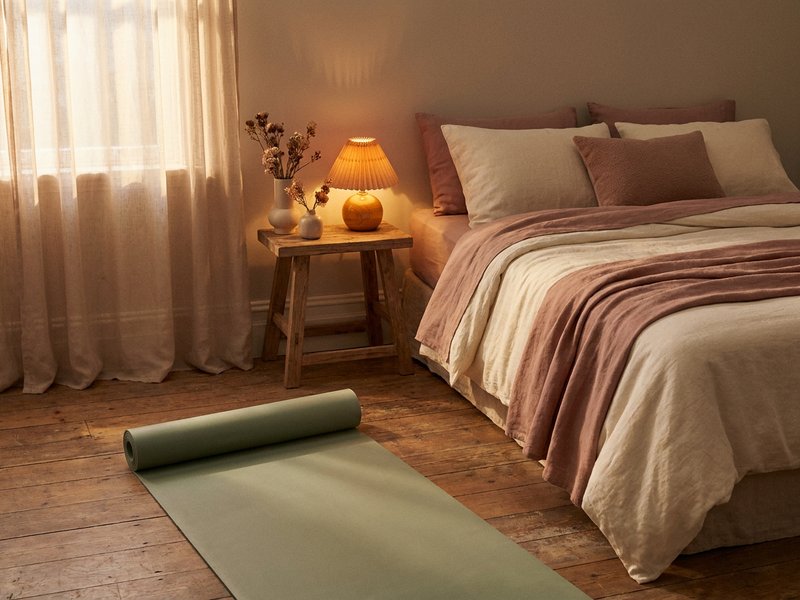
A yoga mat left out on the floor is a free reminder, and a friend booked for the same class is a stronger one. For a longer comparison of movement styles, see yoga vs Pilates for ADHD women.
How Do You Make a Yoga App Stick?
Tie it to something you already do, keep it short, and lower the bar on purpose. Five steps turn a download into a habit:
- Anchor it to bedtime or coffee. A habit with a cue survives a bad day.
- Start at 5 minutes. A session you finish beats a session you plan.
- Save 3 favorite classes. Choosing is the step that stalls you, so remove it.
- Leave the mat out. A rolled mat in a closet is a barrier.
- Allow music or white noise. If silence is hard, add sound.
What if you skip a week? Open the app the next day, pick a 5 minute class, and skip any catch up. A gap is data about your energy, not a failure.
Which Yoga App Should You Start With?
Start with free Yoga With Adriene on YouTube if you want company, and Down Dog if you want the session chosen for you. Use the 7 day trials before you pay for anything else. Save the $130 a year libraries for later, once a 10 minute habit has held for a month.
Pick the setup that survives your worst Tuesday. One woman who had not worked out for 6 years blamed herself after apps, YouTube videos, and squats at the sink all failed. A friend, a 6 month studio pass, and 3 classes a week finally worked. Another woman does one video at bedtime. Both count. You’re not behind. You’re just differently wired.
Found this helpful? Pin this guide so you can come back to it anytime.
Frequently Asked Questions
What is the best yoga app for ADHD?
Down Dog is the best fit when you want the session chosen for you, because you pick style, length, and voice in a few taps. Free Yoga With Adriene on YouTube is the best fit when you want a friendly teacher at no cost. Try both before paying for a library.
Is Down Dog good for ADHD?
It can be, because it removes decisions. You choose a style, a length, and a teacher voice, and the app builds the class. One commenter says it works for her because there are so few barriers to getting started. Listings run $39.99 to $59.99 a year.
Can yoga help ADHD symptoms?
A randomized trial of 82 adults with ADHD found that a 12 minute beginner Hatha yoga session improved temporal impulsivity, but not attention or movement. One session is not a treatment, so use yoga as a support alongside medication or therapy that your clinician recommends.
How long should a yoga session be with ADHD?
Start with 5 to 15 minutes. The trial above used 12 minutes in total, with 10 minutes of floor poses. A short session you finish builds the habit faster than a 60 minute class you skip.
Is there a free yoga app for ADHD?
Yes. Yoga With Adriene is free on YouTube, and Insight Timer offers free live yoga classes and more than 250,000 guided meditations. Paid plans run from $9.99 to $30 a month, and most offer a 7 day free trial.