This reflects my personal experience with ADHD. What works for me may not work for everyone.
The version of minimalism that helps a differently wired brain is about spending fewer decisions, not about bare walls. ADHD minimalism counts what each object will ask of you later, because attention is the currency running short. I have a great job. I manage two kids. By every external measure I have it together, and my house looks like a disaster. For a long time I read that as proof something was wrong with me specifically. This guide covers what the practice actually is, why clutter costs your brain more, why the bare room version backfires, and how to start in one drawer.
Minimalism helps ADHD brains when it means fewer items to manage, and hurts when it means hiding everything behind closed doors. Start with one drawer, one category, and one 20 minute session a week. Keep what earns its place where you can still see it.

Save this for later
You will want this again. Pin it to your planning board so it is one tap away when you need it.
Pin it for laterWhat Is ADHD Minimalism, Actually?
ADHD minimalism is a version of owning less that is organized around decision load instead of aesthetics. The goal is not an empty shelf. It is a home where fewer things are asking you to do something about them.
So what separates it from the minimalism on your feed? That version counts objects and photographs well. This one counts decisions and shows up in how your Tuesday evening goes. A single mug on a counter is not clutter because it is ugly. Its weight comes from the unfinished decision it holds: wash it, move it, or walk past it again.
Three things separate the ADHD version from the mainstream one. Useful items stay visible rather than hidden. Chores get shorter by losing steps, not by gaining a new routine. The unmade decision counts as the real weight, not the object itself.
Why Does Clutter Cost an ADHD Brain More?
Clutter costs more because every visible object competes for the same attention your brain already rations, and because each one carries a decision you have not made yet. The pile is not just ugly. It is a stack of open tabs.
Here is the first mechanism. When several objects sit in your visual field at once, they suppress each other’s representation in the visual cortex, so singling one out takes more effort. Researchers at Princeton demonstrated this competition directly in a 2011 study published in the Journal of Neuroscience. Every brain pays this tax. A brain that already struggles to filter pays it twice.
The second mechanism is storage. Difficulty holding and organizing information sits among the core adult signs listed by the National Institute of Mental Health. Working memory is the desk your brain works on, and clutter keeps stacking paperwork on it. So why does a cleared room feel like someone handed you energy back? Because it did. Ten fewer objects in view means ten fewer small pulls on a system running near its limit.
The Bare Room Trap
Stripping a room bare backfires for most ADHD women, because out of sight really does mean out of mind. Classic minimalism solves visual noise by putting everything behind a door. That single move deletes the cue your brain was using to remember the item exists.
You know the pattern already. Vitamins go in the cabinet and stop being taken. Your good scissors go in a drawer and get replaced twice. That sewing kit goes in the closet and resurfaces in a move, three years later, still unopened.
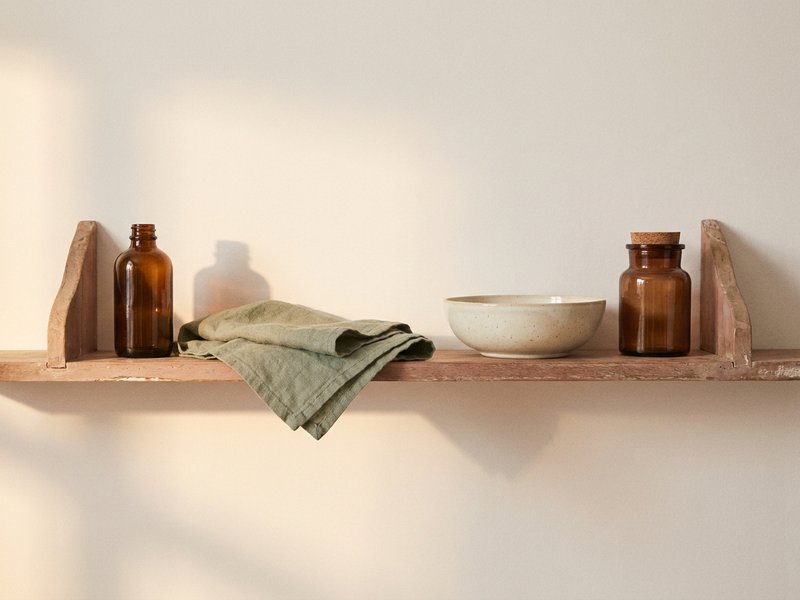
What is the way through, then? Fewer things, still in sight. That combination is the whole point: you cut the count down until an open shelf looks calm instead of crowded, and then you leave it open. Soft, visible storage is a regulation tool rather than a decorating choice, which is why the aesthetic ADHD spaces and soft decor corner of this site keeps circling back to it.
How Do You Start When Everything Feels Like Too Much?
Start with one drawer you open every day. Empty it onto a towel, put back only what you touched in the last 30 days, and stop there. One finished drawer teaches your brain more than a whole weekend plan.
Why a drawer and not a room? Because a drawer is bounded. A room has no edges your brain can trust, so the task quietly grows while you work, while the drawer simply ends. Finishing it hands you the one thing a big plan never delivers on day one, which is proof.
Three rules keep the first pass from stalling. Set a timer for 20 minutes and stop when it rings, even mid drawer. Use a towel or tray so the emptied contents have an obvious edge. Keep a single bag by your foot for anything leaving, so the leaving pile never becomes its own project.
Fewer Things Beats a Better System
The fastest way to shrink a chore is to own less of whatever the chore is made of. Most organizing advice adds structure on top of the same volume. ADHD minimalism goes underneath and removes the volume instead.
One of the sharpest versions of this I have read came from another woman with ADHD: “I keep one set of dishes out and the rest in storage. If I want to eat, I wash the one bowl. No pile up, no dishwasher cycle that never gets unloaded, no seven glasses migrating around the apartment. Sometimes the simplest system is just fewer things.” Nothing about that requires gentle consistency or a new app. It requires 6 fewer plates.
Run the same math on your own worst chore. Laundry is heavy partly because of how many clothes cycle through it. Dishes pile because of how many dishes exist. Surfaces stay covered because of how many small objects have nowhere obvious to land. Cutting the count is the one intervention that keeps working on a day when nothing else does, and it fits the rest of the ADHD home organization ideas that survive past month one.
What Do You Do With Things You Cannot Decide On Yet?
Put them in one covered basket and give the decision a scheduled time instead of a daily one. The indecision is the bottleneck, not the object.
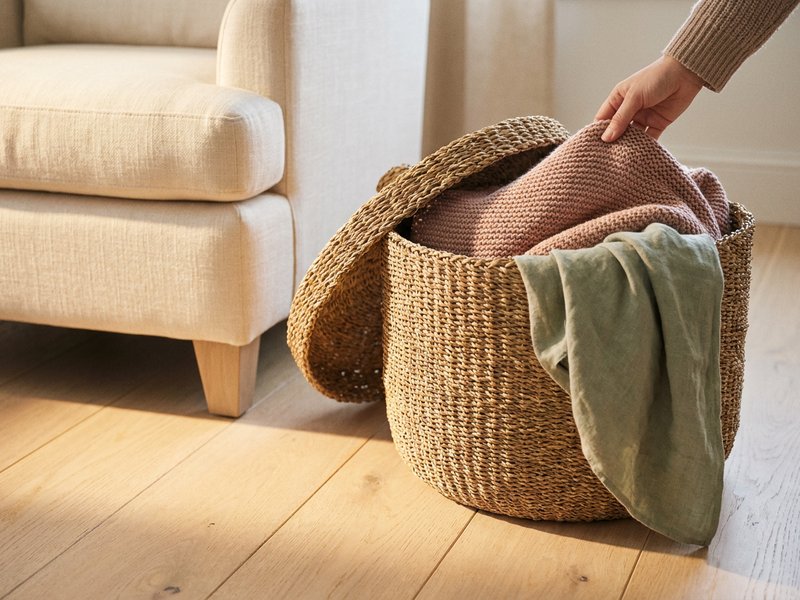
Professional organizers who work with ADHD workflows push back on treating a catch all container as a personal failure. One widely used label gives the idea legitimacy: “DOOM baskets stand for Didn’t Organize, Only Moved,” and the recommended version is large, attractive, and covered. The system works because it splits two jobs an ADHD brain struggles to do at once. Moving an item out of the way happens now. Deciding its permanent home happens later, in one 20 minute weekly session instead of dozens of micro decisions scattered through the day.
What keeps a basket from turning into a graveyard? The scheduled session, and only one basket per floor. Two baskets become storage. One basket stays a queue.
Why Do Decluttering Plans Collapse by Week Two?
They collapse because a fresh method starts looking better than the one you are halfway through. The novelty is the trap, and it arrives right as the first system gets boring.
Lisa Woodruff is a professional organizer who has spent years coaching adults with ADHD. She names one pattern as the biggest she sees: “The number one mistake I see people make is that they try different organization systems all the time.” Her fix is unglamorous. Pick one structured plan, then follow it to the end even when a newer method looks better partway through. She runs a 100 day program built on exactly that premise.
So how do you tell restlessness from a real mismatch? Ask whether the current method has failed you 3 times, or only bored you once. Boredom asks for a podcast and a timer. A genuine mismatch shows up as the same specific step failing over and over, which is information worth acting on. When the switching is really about the fear of doing it wrong, that belongs with soft self care for ADHD women rather than with another storage purchase.
What It Looks Like on a Low Dopamine Day
On a low dopamine day, ADHD minimalism stops being a project and becomes a floor. The floor is the smallest version you can still do while feeling terrible.
Mine looks like three things. Clear one surface, usually the kitchen counter, and leave the rest. Put 5 items in the leaving bag, counted out loud so the number is real. Fill the covered basket instead of solving anything, because moving is allowed even when deciding is not. Does that count as progress on a day you spent mostly horizontal? It counts, and the counter proves it tomorrow morning.
This is where the difference between the two minimalisms shows up most. A bare room standard turns a hard day into evidence against you. Measuring by decision load instead lets that same day cost 5 items and nothing else. This works for me. It might not for everyone.
A Gentle 7 Day Start
Seven small sessions build more usable space than one exhausting weekend, because none of them depend on how you feel that morning. Each day below takes 20 minutes or less:
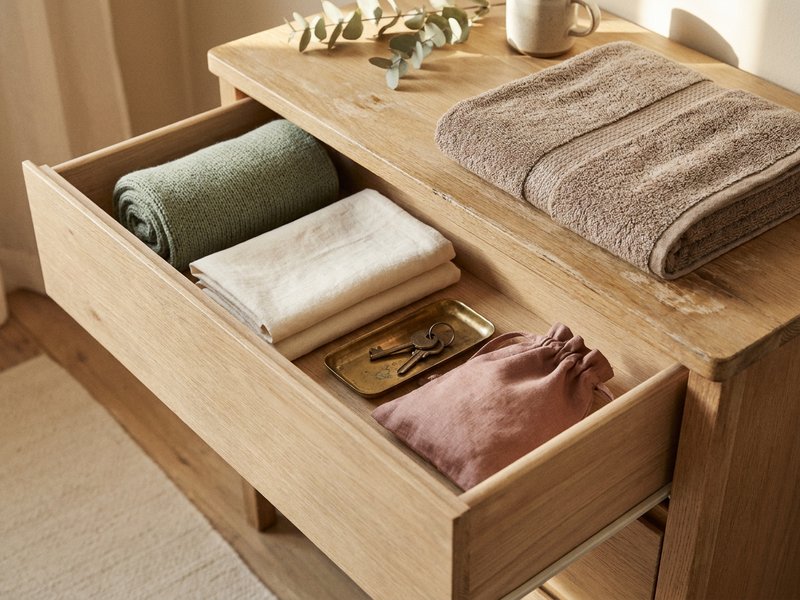
- Day 1. One drawer you open daily. Keep only what you touched in the last 30 days.
- Day 2. Buy or claim one large covered basket. Put it where the pile already forms.
- Day 3. Pick your worst chore and cut its raw material by half: dishes, mugs, or towels.
- Day 4. One flat surface. Clear it fully, then leave 3 items on it that earn their place.
- Day 5. Open one closed cabinet. Move the 3 things you forgot you owned into sight.
- Day 6. Fill the leaving bag to the top and put it in the car, not by the door.
- Day 7. Sit in the space for 10 minutes doing nothing. This step is the reward, and skipping it is why the last attempt felt joyless.
Notice what is missing from that week. No labels, no matching containers, no before and after photo set. Where did the pretty part go? It waits until the volume is down, because containers bought first just organize the excess you were about to remove.
My small win was getting back into a room I had lost. For months the back room was a wall of moving boxes, the sofa in pieces, no light, no space, and I could not face it alone. So I finally asked for help. A cousin and a friend came over, and between the three of us we cleared it. This morning I am sitting in it with the windows wide open.
That is what fewer things actually buys you. Not a room that photographs well, but a room you can walk into. Start with the drawer. You’re not behind. You’re just differently wired.
Save this for later? Pin the 7 day start so it is one tap away on the day the piles win.
Found this helpful? Pin this guide so you can come back to it anytime.
Frequently Asked Questions
What is ADHD minimalism?
ADHD minimalism is owning fewer things so your brain makes fewer decisions, rather than styling a bare room. Each object carries an unfinished decision, and a differently wired brain pays that cost at a higher rate. The measure of success is an easier Tuesday, not an emptier shelf.
Is minimalism actually good for ADHD?
It helps when it means fewer items to manage and hurts when it means hiding everything behind closed doors. Out of sight becomes out of mind for most ADHD brains, so the version that works keeps useful things visible. Fewer things, still in sight, is the combination worth aiming at.
How do I start decluttering with ADHD?
Start with one drawer you open every day, set a 20 minute timer, and put back only what you touched in the last 30 days. Keep a single bag at your foot for anything leaving. One finished drawer gives your brain proof, which a weekend plan never delivers on day one.
Does ADHD minimalism work for women diagnosed late?
Yes, and it often lands harder for late diagnosed women who spent decades reading a messy home as a character flaw. Cutting the number of items removes the load rather than demanding more effort. That reframe tends to matter as much as the space you get back.
Why does my house get messy again after I declutter?
Usually because the volume came back or the system changed. Switching methods is the most common reason organizing attempts collapse, so finish one plan before trying another. Add a covered basket and one 20 minute weekly session to catch the drift before it becomes a pile.