
This reflects my personal experience with ADHD. What works for me may not work for everyone. This post contains affiliate links. I may earn a small commission at no extra cost to you. I only recommend things I genuinely use.
Most cleaning systems are built for a brain that remembers to check them. An ADHD chore chart sticks when it lives where the mess actually happens, counts real minutes instead of vague tasks, and survives a skipped day without collapsing. One woman in r/adhdwomen named the strange part out loud: she washes every dish in someone else’s kitchen, while three mugs sit on her own counter for a week. The standards were never missing. This guide covers why charts fail, how long chores really take, where to put the chart, and what to run on a flat day.
Build the chart around 3 rules: put it on the surface where the chore happens, write the true minute count next to each task, and design a reduced version for bad days. A chart you can see and finish in 4 minutes beats a full schedule you avoid.


Save this for later
You will want this again. Pin it to your planning board so it is one tap away when you need it.
Pin it for laterWhy does every ADHD chore chart fail by week two?
Because it asks you to remember to look at it, and remembering is the exact thing that is unreliable. A chart in a drawer, a chart in an app behind 2 taps, and a chart on the inside of a cupboard door are all invisible by Thursday. The chore was never the hard part. Finding the chart was.
So is it a standards problem? Almost never. A woman in r/adhdwomen describes being a nightmare to live with and a model houseguest at the same time. She would sooner die than leave a dish in someone else’s sink, and her own counter has held the same 3 mugs for a week. Her read on it is the useful one: the standards are there, they just switch on when the space is not hers to relax in.
That gap tells you what the chart has to replace. In someone else’s kitchen, the accountability is in the room with you and the setting is novel enough to hold attention. At home there is neither. A chart that works is one that puts a little of both back: something visible, and something that changes.
What actually makes a chore chart work?
Three design rules, and they matter more than what the chart looks like. It has to be visible from where you stand, honest about how many minutes each job takes, and built so a missed day costs nothing.
- Visible where the chore happens. The kitchen list lives in the kitchen, and the laundry list lives on the machine. A single master chart in the hallway is a chart nobody reads.
- Measured in real minutes. Every line carries a number you have actually timed, not a guess.
- Survivable. No streaks, no boxes that stay empty and stare at you. A blank Tuesday means Tuesday was blank, nothing more.
What happens if you break rule 3 and add a streak counter? The chart stops being a tool and becomes a scoreboard, and a scoreboard you are losing on gets hidden. Streaks reward the weeks you were already fine and punish the weeks you needed help.
How long does each chore really take?
Far less time than it feels like, and the gap between the two is the whole problem. Professional organizer Lisa Woodruff timed emptying her dishwasher with a stopwatch after years of avoiding it. It took 4 minutes. She had been treating it as a 20 minute job, which made it something to schedule rather than something to squeeze in.
Her line about it is the one worth keeping: knowing the chore takes 4 minutes allows her to fit it in here and there rather than avoiding it. That is a time perception problem, not a motivation problem. The National Institute of Mental Health describes difficulty with planning and organising tasks as a core adult presentation, and time estimation sits underneath both.
So how do you fix an estimate you cannot trust? Time it once. Take a phone timer, run the chore, and write the real number on the chart. Do that for 5 jobs and half your list stops being frightening, because most of it turns out to be under 6 minutes.
Where should the chart live?
On the surface you already touch on the way past, never in a drawer or an app. Out of sight really is out of mind for a lot of differently wired women, so an object stored tidily is an object deleted.
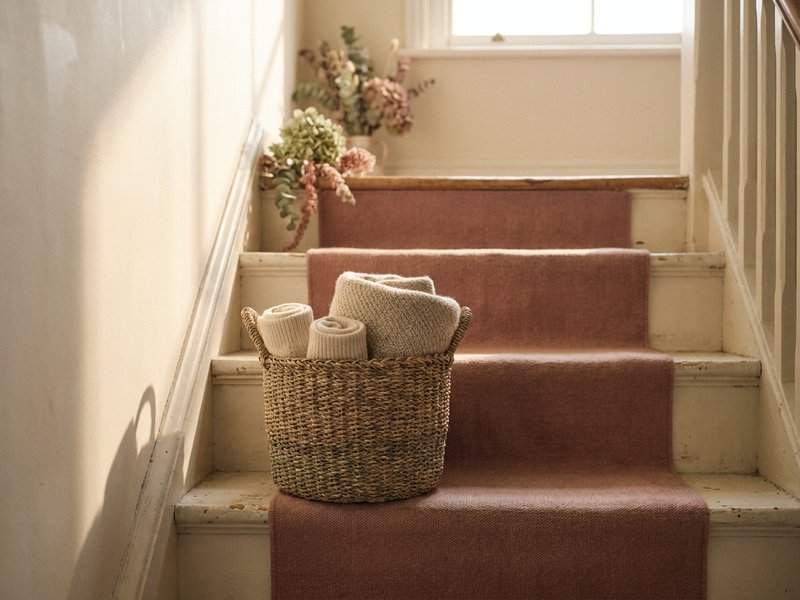
The principle comes through clearly in something a woman on r/adhdwomen wrote about her house. She stopped fighting the sock pile on the stairs and put a small basket there instead. Every room got a charging cable, and there is a spare toothbrush kept downstairs. None of it is elegant. It is her admitting where her brain actually puts things, and meeting it there rather than where it should go.
Apply that to the chart itself. Put the kitchen list at eye height beside the kettle, the bathroom list inside the mirror cabinet you open every morning, and the laundry list taped to the lid of the machine. You are not designing a command centre. The point is leaving notes along a path you already walk.
Which 7 chores hold a home together?
Seven, and together they run about 35 minutes. Everything else is seasonal or optional, which is worth knowing on the days when the whole house feels like the assignment.
- Empty the dishwasher. 4 minutes. The gateway chore, because a clear machine means dishes go in rather than beside the sink.
- Clear one flat surface. 5 minutes. Pick the counter, the table, or the chair you throw clothes on.
- One load in, one load out. 3 minutes of actual handling, spread across the day.
- Wipe the bathroom sink. 2 minutes with a cloth kept in that room.
- Bin round. 5 minutes for kitchen, bathroom, and bedroom together.
- Floor pass in one room. 6 minutes, whichever room looks worst.
- Reset the entry. 10 minutes on shoes, post, and bags so tomorrow starts clean.
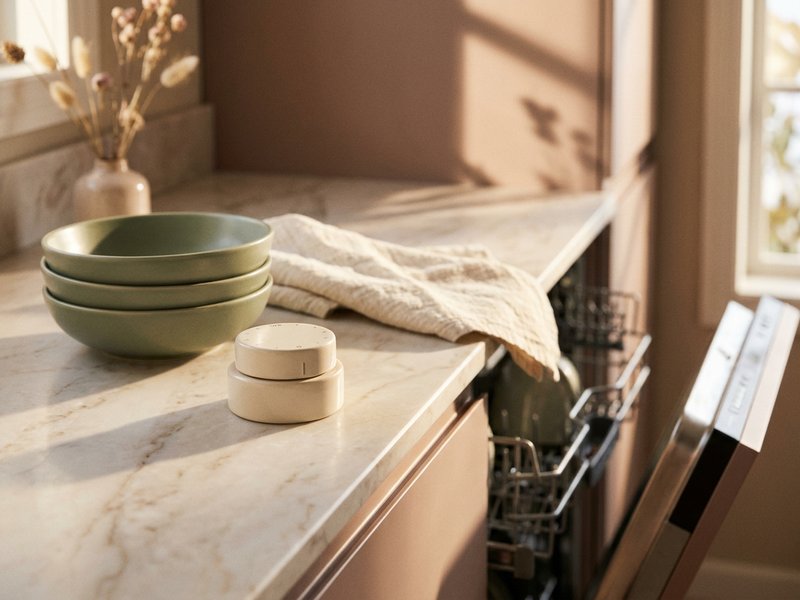
A visual countdown helps more than a phone timer here, because a phone opens 4 other things on the way. I keep a small visual countdown timer on the kitchen shelf and set it before I start. The end of the chore becomes something I can see rather than something I have to feel.
How do you build the chart in one sitting?
In about 20 minutes, using 4 steps and nothing you have to order first. Start on paper, move to something permanent only once the list has survived a fortnight.
- List the 7. Write the chores above, or your own version, one line each.
- Time 5 of them this week. Write the real minutes next to each. Guesses do not count.
- Split by room. Cut the master list into 3 small lists and put each one in the room it belongs to.
- Mark the reduced version. Circle the 2 lines you would still do on your worst day.
Paper works for the first fortnight. After that a small magnetic dry erase board on the fridge holds up better, mostly because wiping a line feels good and rewriting the list every week keeps it slightly novel.
Does the list get shorter over time? It should. If 3 chores keep failing every week, the answer is usually fewer objects rather than better systems, which is the argument behind less stuff and less overwhelm at home. A chart cannot outrun the volume of things it is asked to manage.
What do you run on a low dopamine day?
The 2 lines you circled, and nothing else. Deciding the reduced version now is the point, because a flat Tuesday has no capacity left for designing a smaller plan.
Mine is the dishwasher and one flat surface. That is 9 minutes, and it keeps the house from tipping into the state where restarting costs a whole weekend. What about the days when even 9 minutes is beyond reach? Then it is the dishwasher alone, and the day still counts as a day the system held.
Clothes are usually the first thing to go on those days, and they are also the fastest to snowball, which is why a smaller wardrobe carries so much of the load. The same thinking runs through closet organization ideas that hold up: fewer decisions, in the place the decision happens.
Why does the reset beat the streak?
Because a streak measures the past and a reset only asks about the next 10 minutes. Motivation for a differently wired brain runs on what is available now, not on what was earned last week, so a system that leans on accumulated credit falls over exactly when it is needed.
There is a mechanical reason the reset works better. Starting is the expensive part. A 4 minute job with a visible end lowers that cost enough to get moving. Add a 7 day streak with 3 days missing and the cost goes back up, because now shame is attached to the same task. Adult treatment approaches, including the behavioural strategies listed by the Centers for Disease Control and Prevention, lean on structure and cues rather than willpower for this reason.
So what does a good month look like? Around 18 days where something on the chart got done, several days where only the reduced version ran, and no week where a blank stretch made you throw the whole thing away. That is a working system. It is not a clean house every day, and it was never supposed to be.

Save this for your next reset day
Pin this so the 7 chores and their real minute counts are one tap away on the evening the house has got away from you again.
One woman counted her win as the mail doom pile, finally. Months of envelopes had stacked up untouched. She tore off the names and addresses for shredding, boxed the rest for recycling, and started scanning the ones that mattered. It sounds small next to a whole house. That pile had been quietly stressing her for half a year, and the relief was not small at all. Start with the 4 minute chore and let the chart earn your trust slowly. You’re not behind. You’re just differently wired.
Found this helpful? Pin this guide so you can come back to it anytime.
Frequently Asked Questions
What is an ADHD chore chart?
It is a short list of household jobs with the real minute count written beside each one, kept in the room where the job happens. It differs from a standard chart by dropping streaks and rewards, because a blank day has to cost nothing for the system to survive.
How do I make a cleaning schedule that works with ADHD?
Time 5 chores with a stopwatch, write the true numbers down, then split the list by room so each part lives where you already stand. Circle the 2 lines you would still manage on your worst day. That circled pair is the version that keeps the house steady.
Why can I clean other people’s houses but not my own?
Another home supplies 2 things yours does not: someone watching, and a setting new enough to hold your attention. Women describe washing every dish at a friend’s place while their own mugs sit out for a week. The standards are intact. The conditions around them are different.
How long should ADHD cleaning tasks be?
Most core chores run between 2 and 10 minutes once timed, and the 7 that hold a home together total around 35. Emptying a dishwasher takes about 4 minutes, not the 20 it feels like. Timing them once is what makes the list stop looking impossible.
What is the best chore chart for ADHD women with late diagnosis?
The one you can see without opening anything. A paper list beside the kettle beats an app behind 2 taps, and a small dry erase board beats paper after a fortnight because rewriting it keeps the list slightly new. Visibility matters more than the format.