
Back to school productivity for an ADHD mom holds up when the system lives outside your head, on one surface the whole family walks past. Most school year setups collapse in week two, and the reason is structural: one person is holding every moving part alone. I had a whole structure. Alarms, meal times, homework windows, a bedtime rotation. By week two it was down to one alarm going off at 8am while I lay there not knowing what day it was. The structure didn’t fail because I wasn’t trying hard enough. It failed because I was the only one holding it up.
Build the school year system once, on a calm Sunday, and put it somewhere visible instead of inside an app. One shared surface, one launch pad by the door, and one paper basket carry more weight than any planner. Expect week three to wobble, and plan the repair before it happens.

Save this for later
You will want this again. Pin it to your planning board so it is one tap away when you need it.
Pin it for laterWhy Does the School Year Break an ADHD Mom’s System by Week Two?
It breaks because the setup depends on one brain holding every deadline, and that brain is already running at capacity. August feels calm. You have space to think, so you build something detailed: color coded folders, a shared calendar, a rotating dinner plan.
September removes the space you built it in. Now the same system has to run while you are packing a lunch, finding a permission slip, and answering a question about a science project you are hearing about for the first time. What actually changed? Not your effort. The load moved from planning to retrieval, and retrieval is the expensive part for a differently wired brain. Trouble with planning, task initiation, and follow through sits among the core adult signs described by the National Institute of Mental Health.
Here is the mechanism worth naming. Every item you keep in your head costs working memory, and working memory is the first thing to go under morning pressure. A system stored in your head is not a system. It is a second job.
What Should You Set Up Before the First Bell?
Spend 20 minutes on a calm Sunday writing down what every regular activity needs, so morning you never has to rebuild it from scratch. This is the single highest value hour of the whole school year, and it happens before the year starts.

I keep a note on my phone for every activity we do regularly. The place, what to pack, and the exact time we need shoes on. I build it once when my brain is calm, so morning me doesn’t have to reconstruct it from scratch under pressure. It works for me. It might not for you, but moving the thinking out of the moment is the only reason we leave on time.
Write one entry per recurring thing. Swim lesson: pool on Oak Street, bag with towel and goggles and a snack, shoes on at 4:15. Library day: books in the blue tote by Wednesday night. Early band practice: leave at 7:10, not 7:25.
Why write the shoes on time instead of the start time? Because the start time is the thing that makes you late. Working backward from the door is the whole trick, and it takes 30 seconds per activity to do once.
Where Should the Family Information Live?
On one visible surface that the whole family walks past, not inside an app that only you remember to open. A wall calendar by the kitchen door, a whiteboard beside the fridge, or a single corkboard all work. The surface matters less than the walking past.
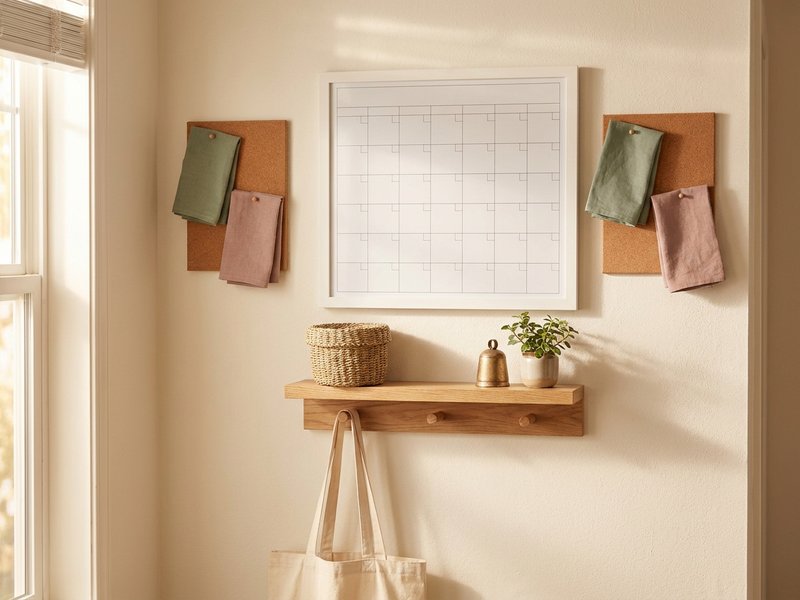
Digital tools ask you to remember they exist. That request lands differently on a brain that drops the thought between the doorway and the phone. Ambient information does not ask anything. You see it because it is in your path.
Three rules keep the surface alive. Put one thing per line, never a paragraph. Write only what changes week to week, so the permanent stuff lives in your phone note instead. And let anyone in the house add to it, including the child who suddenly needs a poster board.
That last rule is the one that saved my week two. A shared surface stops being yours to maintain alone, which is exactly what a collapsing structure needs. You can see the same thinking applied to the rest of the house in my productivity and planners corner of the site.
How Do You Build a Launch Pad That Actually Works?
Give every person one landing spot by the door, load it the night before, and never move it. A launch pad is one tray, hook, or basket per person, placed where you physically pass on the way out.
Load it at a fixed moment, not when you remember. After dinner works for most families because everyone is already in one room. Backpack goes on the hook. Water bottle goes in the tray. Anything that has to leave the house tomorrow goes there tonight, including the library books and the signed form.
What if your child forgets to load theirs? Then the launch pad is doing its job, because the gap is visible at 8pm instead of 7:50am. An empty hook is information. A packed hook is a morning you get to skip.
Do You Actually Need a Planner for This?
No, and buying one before the system exists is the most common way this goes wrong. A planner stores information. It does not deliver information to you at the moment you need it, and delivery is the part that breaks.
Buying a planner and abandoning it within months is a repeat pattern in ADHD reader comment sections, not an isolated complaint. One ADDitude commenter summed up the cycle: “It is a beautiful planner that I have had for about 6 months and have used one page total.” Dozens of replies on the same 2019 post describe the identical arc: initial excitement, one or two entries, then months of an untouched cover. That pattern points to a mismatch between task initiation and planning tools, not a lack of desire to get organized.
The numbers behind the marketing are quieter than the marketing. A 2026 ClickUp post cites internal insight data showing that “Only 12% of people use physical journals to track their goals, and a surprising 38% aren’t tracking at all.” That leaves roughly half on scattered digital tools or nothing consistent, and the gap widens for adults whose working memory is already carrying the household.
So when does a planner earn its place? After the wall surface and the launch pad have run for a month. Buy the tool that supports a habit you already have, not the one you hope will create it.
What Does the Homework Hour Need?
A fixed start signal, one cleared surface, and a visible end point. Homework rarely fails on difficulty. It fails on the transition into it and the fog about when it ends.
Use a sound, not a sentence. A phone alarm labeled “homework starts” pulls better than you calling up the stairs, and it takes the nagging out of your voice. Set a visual timer on the table so the finish line is a shape, not an argument. Sit nearby with your own quiet task if your child works better with company, which is body doubling and it works on adults too.
Why does a shape beat a number? Because a countdown you can see gives a brain with a shaky sense of time something to steer by. The same reason a visual timer earns its spot on my desk shows up in the 20 ADHD tools I use daily.
How Do You Handle the Paper Avalanche?
One basket takes every piece of paper the day produces, and you sort it once a week, not once a day. School paper arrives faster than any filing system survives.

Put the basket where the backpacks land, so the paper never reaches a counter. Then pick one 10 minute window a week, the same window every week, and empty it into three piles. Act on it now, keep it, recycle it. Most of the basket is the third pile.
Anything with a date goes straight onto the wall surface before the paper leaves your hand. Field trip on the 14th. Picture day on the 22nd. Early release on the 30th. The paper can then go in the basket with everything else, because the date is already somewhere you will see it.
Which Mornings Need a Different Plan?
Low dopamine mornings, the day after a bad night, and the first week of a schedule change all need a shorter version of the plan, decided in advance. A system that only runs at full strength is a system that quits on you.
Write the reduced version now, while you are calm, and put it on the same surface. Mine has three lines: shoes, bag, door. Breakfast becomes a cereal bar in the car. Nobody gets a lecture about it, including me.
What about the weeks when even the short version slips? Those weeks are data, not failure. They usually point at a change in the schedule that never made it onto the wall, and finding that gap takes 5 minutes on a Sunday. Time management struggles are among the most commonly reported difficulties for adults with ADHD, according to the CDC, so the wobble is a known feature of the wiring rather than a personal verdict.
What Do You Do When It Slips in Week Three?
Repair one thing, not the whole system, and pick the one that costs you the most mornings. Week three is when the new year stops feeling new and the setup meets an ordinary tired week.
Run this short check instead of rebuilding:
- Is the surface current? An out of date wall calendar gets ignored within days, and then everything on it does too.
- Is the launch pad still by the door? These migrate. A tray that moved to the dining table has stopped being a launch pad.
- Is one person doing all the loading? If yes, that is the repair, and it is a conversation rather than a container.
Fix the one that appears most often, then leave the rest alone for another two weeks. Rebuilding everything in week three is how the September version collapses into the October version of nothing.
What Should the First Week Actually Look Like?
Quieter than you think it should. The first week is for running the system, not improving it.
Keep three things going and let everything else be imperfectly handled. The wall surface stays current. Someone loads the launch pad after dinner. Every page of school paper lands in the basket. That is the whole assignment for week one, and it is enough.
Resist adding a chore chart, a reward system, and a new morning routine in the same fortnight. Three new habits at once is how all three end up gone by October. If you want the calmer version of the mornings themselves, the gentle morning routines corner goes deeper on that piece alone.
I remembered the dress up day before 8am, not at 8:05 in the school parking lot. One small note on the fridge, one quiet morning without the familiar wave of letting someone down. I’m learning to let the ordinary wins land instead of rushing past them.
Start with the surface. Add the launch pad when the surface has run for a week. You’re not behind. You’re just differently wired.
Save this for later? Pin the setup so it is one tap away when the next school year starts.
Found this helpful? Pin this guide so you can come back to it anytime.
Frequently Asked Questions
What is a back to school setup for an ADHD mom?
It is a small set of external supports that hold school year information outside your head: one visible family surface, one launch pad by the door, and one basket for paper. The point is delivery at the right moment, not storage. Build it once, before the year starts.
How do I get my ADHD family out the door on time?
Work backward from the door and write the shoes on time, not the start time. Load the launch pad the night before at a fixed moment such as after dinner. Keep a phone note for each recurring activity listing the place, the bag, and that exact departure time.
Are ADHD planners worth it for back to school?
Not as a starting point. A planner stores information but does not deliver it when you need it, which is where school mornings break. Run a visible wall surface and a launch pad for a month first, then buy a planner to support the habit that already exists.
Why does my school year system fall apart after two weeks?
Because you built it in calm August conditions and it has to run in busy September ones. The load shifts from planning to retrieval, and retrieval costs working memory you no longer have spare. A shared surface fixes this faster than more effort does.
Back to school organization for women with late diagnosed ADHD: where do I start?
Start with the wall surface, because it costs 20 minutes and helps every single day. Add the launch pad in week two and the paper basket in week three. One change at a time holds; three at once is how all three disappear by October.