I’m not a doctor or therapist. This is based on my personal ADHD experience and is for informational purposes only. Please consult a qualified healthcare provider before making health decisions.

A mindfulness practice sticks with ADHD when it is tiny, attached to something you already do, and built around your actual attention span instead of a 20 minute app session. Most mindfulness advice is written for a brain that can sit still and follow a script, which is exactly the part that ADHD makes hard. One woman on r/ADHD described going all in every time: new habit, full system, full commitment, and then three weeks later the whole thing collapses and she could not even look at it anymore. She used to think that meant she was broken. It meant she was building habits for a different kind of brain than hers.
A mindfulness practice sticks with ADHD when it lasts 2 minutes or less, attaches to an existing daily habit like brushing your teeth, and does not require sitting still, since movement based mindfulness like walking or a repetitive craft works as well as seated meditation for most ADHD brains.

Save this for later
You will want this again. Pin it to your planning board so it is one tap away when you need it.
Pin it for laterWhat Does a Mindfulness Practice That Sticks Actually Mean for ADHD?
A mindfulness practice that sticks means one you are still doing after 3 months, not one you started with enthusiasm and dropped by week 2. For ADHD brains, sticking is less about willpower and more about design. The practice has to survive a low dopamine day, a chaotic morning, and a week where you forget it exists. Most mindfulness programs are not designed for that. They are designed for consistency, which is exactly the trait that ADHD interrupts most.
What actually predicts whether a habit survives an ADHD brain long term? Size and attachment matter more than motivation. A tiny practice tied to something automatic, like your morning coffee or your commute, survives the days your motivation does not show up. A big practice that depends on remembering, deciding, and following through in the right order rarely does.
Why Do Most Mindfulness Apps and Routines Fail for ADHD Brains?
Most mindfulness apps fail for ADHD brains because they assume a fixed session length, a quiet uninterrupted space, and a brain that does not resist stillness. A 20 minute guided meditation asks for sustained attention on one narrow target, your breath, which is close to the hardest possible task for a brain built to scan for novelty. When the session inevitably breaks down into wandering thoughts, the app frames it as failure instead of a normal ADHD response.
But does that mean mindfulness itself is the wrong tool for ADHD? Not quite. It means the standard delivery format is the wrong tool. The underlying skill, noticing what is happening in your body and mind without immediately reacting to it, is truly useful for ADHD. The 20 minute seated format most apps default to is just one narrow way to build it, and often the least ADHD friendly one available.
Does Mindfulness Actually Work for ADHD, or Is It Overhyped?
Mindfulness training produces real, measurable improvement in ADHD symptoms, but it does not work the way most marketing claims it does. A 2023 systematic review of 10 controlled trials in adults with ADHD, published on PubMed Central, found statistically significant gains in self reported symptoms and daily functioning. The same review found no significant increase in trait mindfulness itself, the quality the training is supposed to build. In plain terms, adults got measurably better at managing ADHD symptoms without becoming more mindful on the questionnaires designed to measure it.
Why would symptoms improve without the underlying trait changing? One likely answer is that the structure of practicing, not the content of the meditation, does the work. A daily 2 minute check in builds a habit loop your ADHD brain can use as an anchor point, whether or not you become a naturally calmer or more present person in the process. You do not need to become mindful. You need a repeatable moment that interrupts autopilot, and that is a lower bar than most programs claim.
What Is an Anchor Habit, and Why Does It Work Better Than a Routine?

An anchor habit is a tiny action attached to something you already do without thinking, and it works better than a full routine because it does not require remembering a schedule. One mom in the r/ADHDMoms community stopped trying to build routines and started building anchor habits instead: one small thing at the same time every day, attached to something she already did. Two anchors held. Every cleaning chart she had ever made did not. This works for her. It might not for everyone, but the key was tiny and attached, not detailed and flawless.
For mindfulness specifically, good anchors are moments your day already contains: the kettle boiling, the first red light on your commute, or the walk from your car to the front door. Pick one. Attach 60 seconds of noticing your breath or your surroundings to it. The anchor does the remembering so your ADHD brain does not have to.
How Do You Start a Mindfulness Practice in Under 2 Minutes a Day?

Starting in under 2 minutes means picking one anchor, one action, and skipping every optional extra, like a special cushion or a specific app, that adds a decision point before you can begin. Here is the exact starting sequence:
- Pick one anchor moment that happens every single day, like brushing your teeth or waiting for coffee.
- Attach one action: 3 slow breaths, or naming 3 things you can hear right now.
- Set no timer and use no app for the first 2 weeks. The anchor is the only cue you need.
- Do it even on the day you forget until the moment it is already over. A half version still counts.
Should the practice grow once it feels automatic? Only if you want it to. Many ADHD women keep the 2 minute version indefinitely because it is the version that survives a bad week, and a bad week is exactly when the practice matters most.
What Counts as Mindfulness If Sitting Still Doesn’t Work for You?
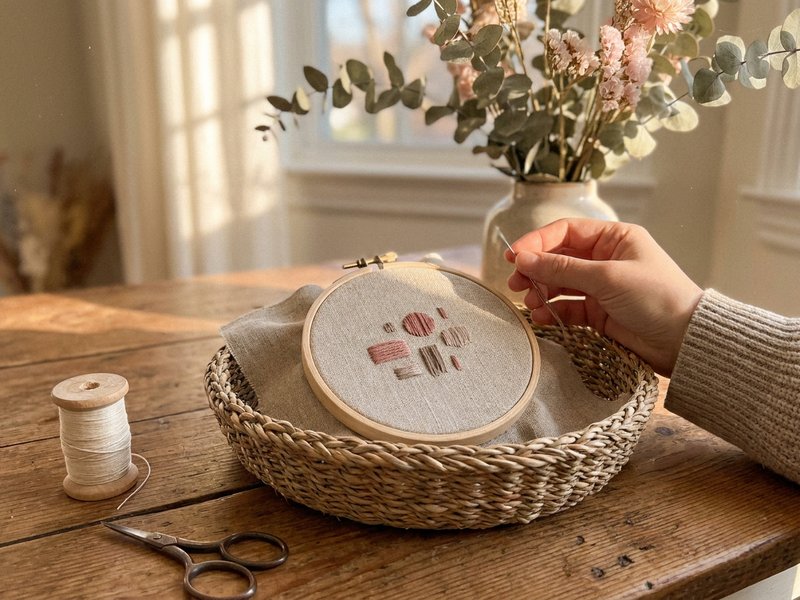
Movement based mindfulness counts just as much as seated meditation, and for many ADHD brains it counts more. A repetitive craft like cross stitch, a slow walk with no destination, or washing dishes without a podcast in your ears can all build the same present moment awareness that seated meditation targets, as long as you bring attention to the sensation instead of running on full autopilot.
What makes a moving activity mindful instead of just busy? The difference is where your attention goes. Autopilot means your hands move while your mind runs three unrelated threads at once. Mindful movement means you notice the actual sensation, the thread pulling through fabric, your feet on the pavement, the water on your hands, even if only for a few seconds before your attention drifts again. Drifting and returning is the practice, not a sign you are doing it wrong.
How Long Before a Mindfulness Practice Actually Feels Automatic?
Most ADHD women report a mindfulness anchor starting to feel automatic somewhere between 6 and 10 weeks of near daily practice, though the exact timeline varies by how strong the anchor cue is. A kettle you use every single morning builds the habit faster than a walk you only sometimes take. The National Center for Complementary and Integrative Health notes that most mindfulness research studies run 8 weeks, which lines up closely with what ADHD women report anecdotally as the point where a practice stops feeling like an assignment.
Does missing days early on reset the timeline back to zero? No. A missed day is a gap, not a restart. The anchor moment, the kettle or the red light, is still there tomorrow whether or not you used it today.
What Do You Do When You Miss a Day, or a Week?
When you miss a day or a week, the single most useful move is to return at the very next anchor moment without adding a story about why you failed. ADHD shame spirals around broken streaks are often what actually kills a mindfulness practice, not the missed days themselves. This works for me. It might not for everyone, but treating a gap as neutral information instead of proof you cannot stick to anything is what let this practice survive longer than every version I tried before it.
If a week turns into a month, do not restart with a bigger version to make up for lost time. Restart with the exact same 2 minute version you began with. The size is what made it work the first time, and adding pressure back in is the fastest way to lose it again.
How Does a Mindfulness Practice Connect to Nervous System Regulation?
A short daily mindfulness anchor trains the same noticing skill that makes it possible to catch nervous system overwhelm before it becomes a full shutdown or a spiral. The 60 seconds you spend noticing your breath at the kettle is the same skill you use to notice your shoulders tightening before a hard afternoon. For a fuller picture of the body signals worth tracking, this guide to regulating your ADHD nervous system covers the broader toolkit mindfulness fits inside.
What Actually Counts as Sticking?
One woman finally found a hobby that actually stuck: cross stitch, started with a cheap kit she was not even sure she would like. Almost every day since, it has quieted the constant chatter in her head. After a lifetime of dropping hobbies within five minutes, 21 months in felt like a real victory. Sticking does not mean never missing a day. It means the practice is still there months later, small and unglamorous and still working. You’re not behind. You’re just differently wired.
Save this guide so the anchor habit idea is easy to find the next time you want to start again.
Found this helpful? Pin this guide so you can come back to it anytime.
Frequently Asked Questions
What is a mindfulness practice for ADHD?
A mindfulness practice for ADHD is a short, repeatable moment of noticing your breath, body, or surroundings without judgment, usually attached to an existing daily habit. It differs from standard mindfulness advice mainly in length and format: 1 to 2 minutes attached to an anchor works better for ADHD brains than a 20 minute seated session.
How do I build a mindfulness habit that actually sticks?
Attach a 2 minute or shorter mindfulness action to something you already do every day, like brushing your teeth or waiting for the kettle. Skip timers and apps for the first 2 weeks, and keep doing it even on days you forget until it is already over. Size and attachment matter more than motivation for ADHD brains.
Is mindfulness actually effective for ADHD, or is it overhyped?
Research shows real symptom improvement from mindfulness training in ADHD adults, though not always through the mechanism marketing implies. Studies find measurable gains in daily functioning without a matching increase in trait mindfulness itself, which suggests the habit of practicing helps more than becoming a calmer person in general.
What is the best mindfulness practice for ADHD women who can’t sit still?
Movement based mindfulness, like a repetitive craft, a slow walk, or mindful dishwashing, works as well as seated meditation for many ADHD brains. The key is bringing attention to the actual sensation instead of running on autopilot, not staying physically still.
Should I talk to a doctor before starting a mindfulness practice for ADHD?
Mindfulness is generally safe as a self led practice and does not require medical clearance for most people. Talk to a doctor or therapist first if you have a history of trauma that stillness or body focused attention tends to activate, since some mindfulness formats can bring up difficult sensations that are easier to navigate with support.