

Journaling for ADHD beginners requires exactly one thing: writing something down, in any form, without needing it to look like a bullet journal. One woman described the moment a reframe changed how she saw her whole life: someone told her that if your answer to “do you struggle with X” is “no, I have a system for X,” the real answer is yes. She had been solving for her own brain for years without realizing that is what a journal actually is.
Journaling for ADHD beginners means writing something down daily, in any format, without a special notebook or method first. Start with one sentence at the same anchor point every day, move the object somewhere you will trip over it, and skip flawless formatting entirely. A system that gets used beats a beautiful one left closed.

Save this for later
You will want this again. Pin it to your planning board so it is one tap away when you need it.
Pin it for laterWhat Does Journaling for ADHD Beginners Actually Require?
Journaling for ADHD beginners requires a place to write and a few minutes, nothing more. It does not require color coding, a specific notebook brand, or complete sentences. Any surface that holds your handwriting counts as a valid start.
Why does dropping the format requirement matter so much? Waiting for the right notebook or the right system is one of the most common ways a beginner never starts at all. The format can change later. Existing at all is what the habit needs first.
Why Do Systems Work Better Than Willpower for ADHD?
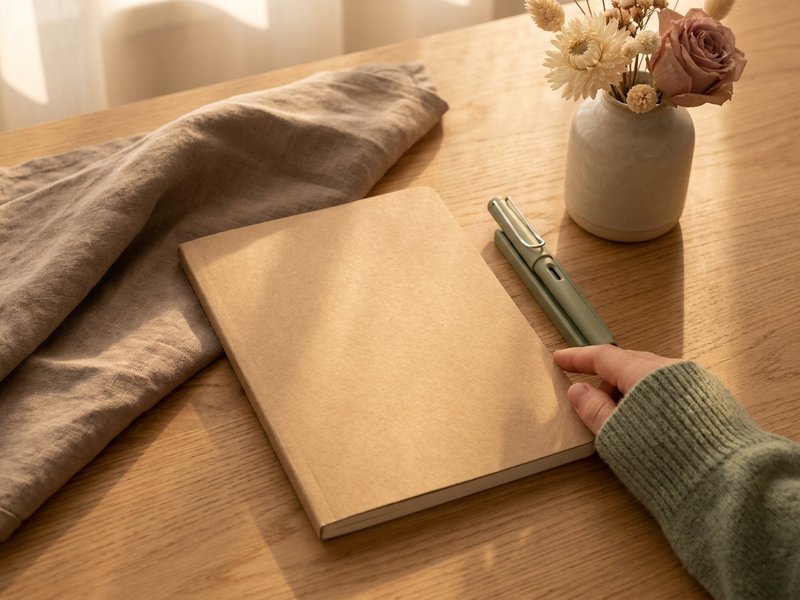
Systems work better than willpower for ADHD because a system carries the weight that memory alone cannot hold. One woman had this reframed for her directly: if your answer to a struggle is “no, I have a system for it,” the honest answer is actually yes, you struggle, and you built a workaround without noticing. That sentence rewrote a lot of her own history.
Does relying on a system mean you are not organized enough to just remember? No. A journal is a system, the same as a labeled bin or a calendar reminder. Building external structure is not a failure of willpower. It is the actual solution.
How Do You Actually Start Journaling as a Beginner?
You start journaling as a beginner by writing one sentence a day, at the same anchor point, for at least a week before adding anything else. Right after coffee, right before bed, or right after brushing your teeth all work as anchors. The sentence can be as plain as “today felt like this.”
What if one sentence feels too small to matter? It is not too small. A sentence you actually write beats a full page you plan to write and never open the notebook for. Size comes later, once the habit survives its first hard week.
Why Does Moving the Object Matter More Than Writing the Note?
Moving the object matters more than writing the note because a note only works if you see it again at the right moment. One woman solved this for her own agenda. She writes everything down, but the real gap was remembering to check it before walking out the door. What worked was moving the object itself, not just the note. If she needs to return something tomorrow, it goes in the car the night before, so the reminder lives where she will physically trip over it.
How does this apply to a beginner journal specifically? Keep the notebook somewhere you already pass, like next to your toothbrush or on your pillow, instead of in a drawer. A journal you see is a journal you use. This works for her. It might not for everyone.
Why Does Writing Things Down Help an ADHD Brain Specifically?

Writing things down helps an ADHD brain because it frees up working memory that repetitive thoughts were otherwise occupying. A study on expressive writing and test anxiety found that participants who wrote about their anxious thoughts before a high pressure task showed significantly lower state anxiety than a control group. Separate research has linked expressive writing to measurable working memory gains weeks later.
Does this mean journaling replaces other regulating tools? No, but it means the benefit is not just emotional. Working memory is already a limited resource in an ADHD brain, so a thought parked on paper instead of on repeat gives that capacity back for something else.
What if You Cannot Think of Anything to Write?
If you cannot think of anything to write, write down the self criticism you are already thinking and question it instead. One woman on r/adhdwomen described the technique that finally worked for her: every time she caught herself thinking she was lazy or selfish, she stopped and asked “Would I say this to a 5 year old?” before evaluating the thought again.
Why does that specific question work as a journal prompt? It reframes self talk into something you would extend to a child, not a rulebook to follow. She called it a slow process at first, but said it made her less angry and less judgmental toward herself over time.
Do You Need a Special Journal or Method to Start?

You do not need a special journal or method to start. Any notebook, a notes app, or the back of a receipt all work equally well for the first week. The CDC’s overview of ADHD in adults notes that symptoms and needs can shift day to day, which is part of why a rigid method chosen too early often gets abandoned once a harder week arrives.
What if you outgrow a plain notebook later? Switch then. Prompts, trackers, and specific formats are worth adding once the daily habit itself is solid, not before it exists.
How Does This Connect to a Full Journaling Routine?
One sentence a day is the entry point, not the ceiling. This guide to starting journaling with ADHD without quitting in a week covers what comes next once the daily habit has held for a few weeks.
What Does Progress With Journaling as a Beginner Actually Look Like?
One woman’s small win was setting up her supplies a full week before the term started instead of scrambling the night before. Everything was sorted, labeled, and packed in one bag by the door. Her old pattern was always a last minute rush and a side of shame. That year she just felt ready, and ready was a feeling she was still getting used to. Progress with journaling as a beginner works the same way. It rarely looks like a finished notebook. One sentence written on a day you almost skipped it is exactly what it looks like. You’re not behind. You’re just differently wired.
Save this before you buy another notebook you will not open.
Found this helpful? Pin this guide so you can come back to it anytime.
Frequently Asked Questions
What does journaling for ADHD beginners actually require?
Journaling for ADHD beginners requires a place to write and a few minutes, without a special notebook, color coding, or complete sentences. Any surface that holds your handwriting is a valid starting point.
How do I start journaling as an ADHD beginner without quitting in a week?
Write one sentence a day at the same anchor point, like right after coffee or right before bed, and keep the notebook somewhere you already pass so you actually see it. Add format or length only once the habit survives its first hard week.
Does journaling actually help an ADHD brain, or is it just a mood thing?
It helps beyond mood. Writing things down frees up working memory that repetitive thoughts were otherwise occupying, and research on expressive writing has linked it to lower anxiety and measurable working memory gains afterward.
What should I write if I cannot think of anything?
Write down the self critical thought you are already having and question it, using a prompt like “would I say this to a 5 year old?” This turns a blank page moment into a real entry instead of an excuse to skip the day.
Do I need a bullet journal or a special method to start journaling with ADHD?
No. A plain notebook, a notes app, or even the back of a receipt works for the first week. Specific methods and prompts are worth adding later, once a plain daily habit has already proven it can stick.