An aesthetic nightstand for ADHD works when it holds fewer things in view, not prettier things. The tension most late diagnosed women hit is wanting a bedside that looks calm while still being able to find what you actually reach for at 11pm. One woman named the exact bind: she does not want everything out because it looks messy and raises her anxiety, but if it is not out she cannot find it, so she ends up on a 35 minute twirl between three hiding places before she finds what she needs. This guide covers what actually earns a spot on a nightstand, why clutter costs more right at bedtime, and 11 specific swaps sorted into light, containment, and reach, plus what to do when space or a shared bed limits your options.
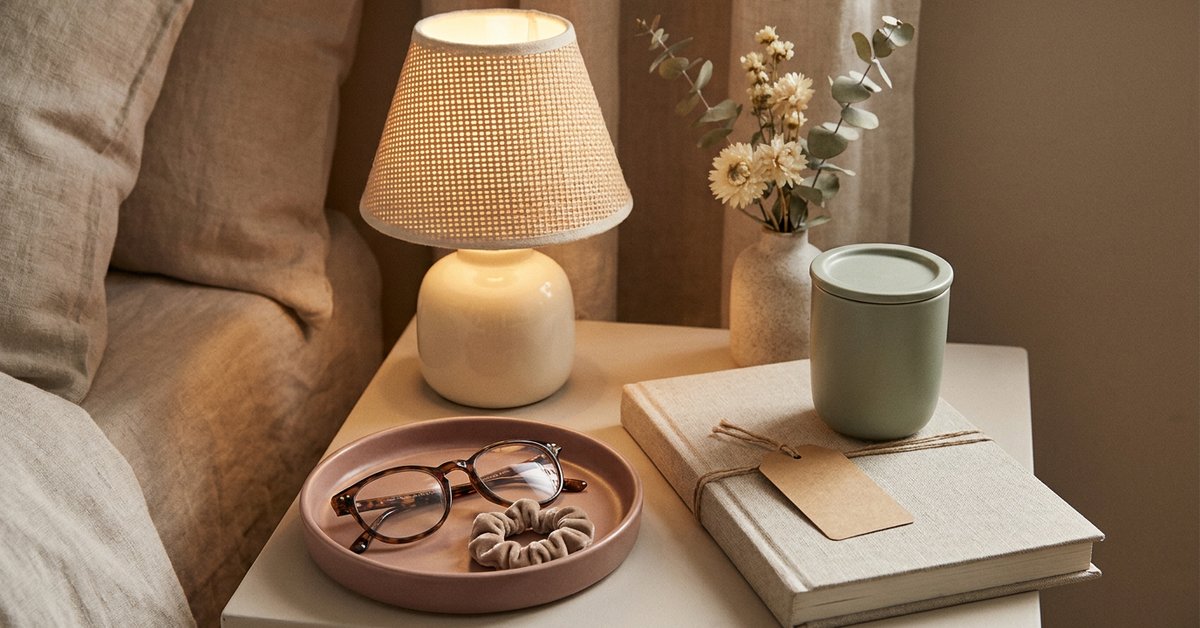
An ADHD friendly nightstand holds 5 items or fewer, each one visible instead of hidden behind a closed drawer front. Warm light under 3000K, one shallow tray for daily objects, and a single covered vessel for water cover most of what a differently wired brain reaches for at night. Cutting the count matters more than any specific product.

Save this for later
You will want this again. Pin it to your planning board so it is one tap away when you need it.
Pin it for laterWhat Makes a Nightstand Actually ADHD Aesthetic?
An ADHD aesthetic nightstand is one where every object is both visible and earns its place, rather than one that simply photographs well. The word aesthetic gets used to mean matching and minimal. For a differently wired brain it has to mean something else: nothing hidden that you need, nothing visible that you do not.
Why does that distinction matter so much here? Because a closed drawer front looks tidy in a photo and erases whatever lives inside it. One woman on the same aesthetic spaces thread put the whole conflict in one line: she has heard 7,000 professional organizers give the standard advice, function first, pretty second, and she still will not use any system unless it is cute first, no matter how sound the advice sounds on paper. That is not vanity. It is that a system she will not look at is a system she will not use.
So what does earn a spot, then? Something you touch most nights, something small enough that 3 to 5 of them do not read as clutter, and something that still looks calm when it is out in the open. The 11 ideas below are built around that filter, not around a Pinterest board.
Why Does Nightstand Clutter Cost More Right at Bedtime?
Clutter costs more at bedtime because your brain is already asking for less input at the exact moment a crowded surface hands it more. The same pile that is invisible to you at 2pm becomes the last thing your eyes land on before the light goes off.
Here is the mechanism. Difficulty holding and organizing information sits among the core adult signs listed by the National Institute of Mental Health, which is exactly the kind of small tracking work a crowded surface adds back in. Perception researcher J.J. Gibson, who taught psychology at Cornell University, described an affordance as a cue an object projects that tells you how to interact with it, rather than a fixed property of the object itself. A labeled bin or an open tray affords putting something back correctly with almost no thought. A drawer with no visible order affords nothing, so every object inside it costs a small decision. Stack 6 or 7 of those decisions on a nightstand and you have built a tiny obstacle course between you and sleep.
Does that mean everything should sit in the open? Not quite, and the next section covers exactly how many objects earns the tradeoff. But the direction is clear: fewer decisions, not fewer things, is the actual goal.
How Many Things Should Actually Earn a Spot?
Cap the surface at 5 objects, and let a shallow tray hold the rest so the count still reads as one thing to the eye. A number gives you something to check against instead of a feeling to argue with.
- You touch it most nights. Charger, glasses, lip balm. Weekly use does not earn a permanent spot.
- It has one job. A single lamp, not a lamp plus a diffuser plus a speaker crowding the same corner.
- It survives being seen. If a specific object embarrasses you every time you glance at it, it belongs in a drawer, not on the count.
What happens to everything that does not make the cut? It moves to a drawer, a closet shelf, or gets donated. The point of the cap is not minimalism for its own sake. It is that a 5 object surface takes under 10 seconds to scan, and a 15 object surface takes long enough that your brain quietly starts avoiding the whole area.
3 Light Ideas That Change How the Room Feels
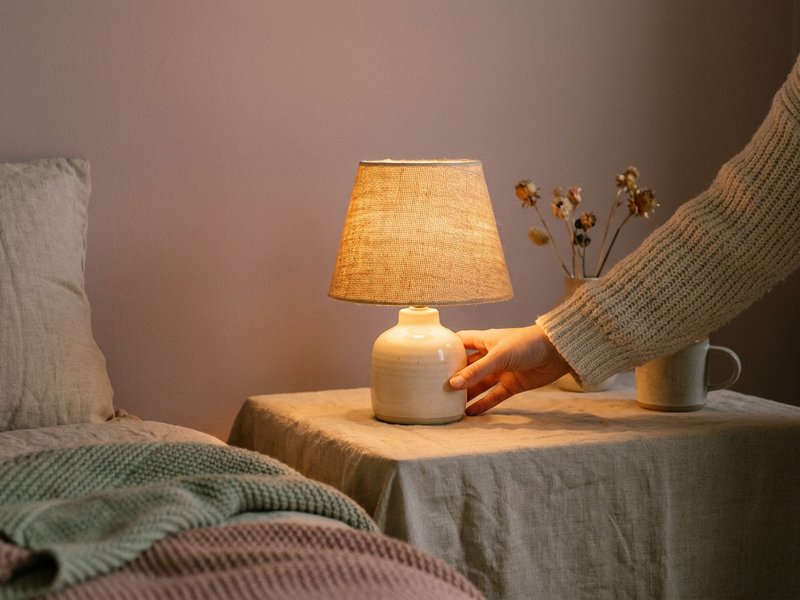
Warm, dimmable light does more for a nightstand’s mood than any single decor object, because it changes the whole room instead of one corner of it. These 3 swaps take under 15 minutes combined.
- Swap the bulb for something under 3000K. A warm bulb reads as evening light instead of daytime light, which matters more than the lamp shape it sits inside.
- Add a smart plug instead of a hardwired dimmer. One tap dims the room from bed, so you are not crossing the floor at 11pm to turn a switch.
- Retire the overhead light from your evening routine entirely. Once the lamp is doing the work, the ceiling fixture only turns back on for cleaning.
A dimmable lamp with a fabric shade covers the first 2 of these at once. Why does the shade material matter here? A fabric shade softens the light further, which reads as calmer than the same bulb behind bare glass.
4 Containment Ideas That Keep the Surface Calm
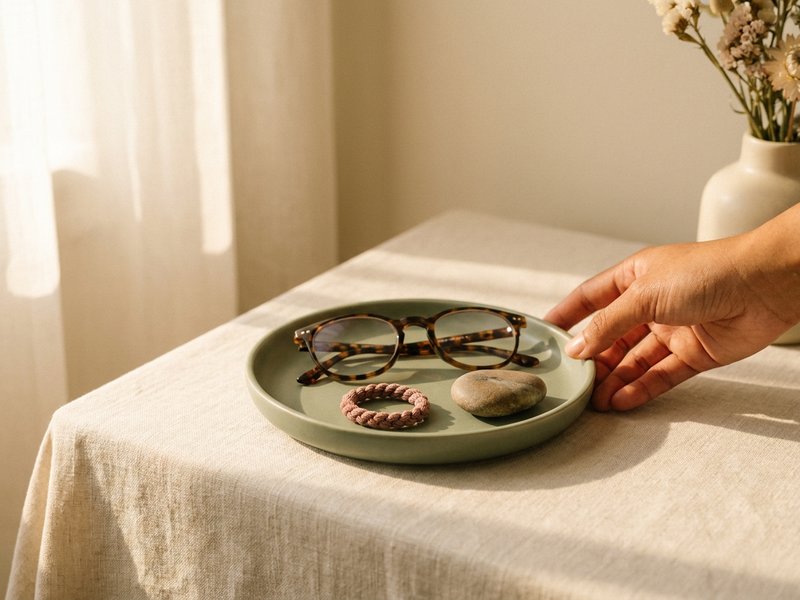
Containment works when it groups objects instead of hiding them, so the surface still reads as visible even with several things sitting on it. The goal is one contained shape, not zero objects.
The same logic shows up everywhere friction actually gets cut, not just on a nightstand. One woman fixed her worst chore, changing the bed, by keeping two full sets of sheets doubled up and ready, so the swap is one step instead of an hours long production. Nothing about that trick is about the sheets specifically. It is about noticing where a task keeps failing and removing a step from that exact spot, and a cluttered nightstand fails at the same place: too many steps between wanting an object and holding it.
- A shallow tray for daily objects. Rings, glasses, a hair tie. One tray reads as a single object even holding 5 small ones.
- A small lidded box for anything you would rather not see. Medication, jewelry you are between wearing. Closed on purpose, not by accident.
- A cord basket for the charger. A loose cable is the single most common reason a tidy nightstand looks messy again by Tuesday.
- One drawer, used for exactly one category. Not a catch all. If it starts holding 3 unrelated things, it has become the junk drawer again.
4 Reach Ideas for What You Actually Use at Night
The objects worth keeping in easy reach are the ones a foggy, half asleep brain still needs to find without thinking. These earn their spot on sensory grounds, not decor ones.
- A covered tumbler or carafe instead of an open glass. Nothing spills if it gets knocked at 3am, and you are not walking to the kitchen for water.
- One texture object. A smooth stone, a soft fabric coaster, something your hand can find without your eyes.
- A single book or journal, closed. One, not the stack of 4 you keep meaning to finish.
- A small candle or a plug in diffuser with a timer. Scent works as a wind down cue the same way dim light does, without adding anything visual to track.
A covered tumbler with a matching lid handles the water piece without adding a plastic bottle to the mix. Why choose covered over an open glass at all? An open glass is the nightstand item most likely to end a good night early.
What If You Share a Bed or Have No Nightstand at All?
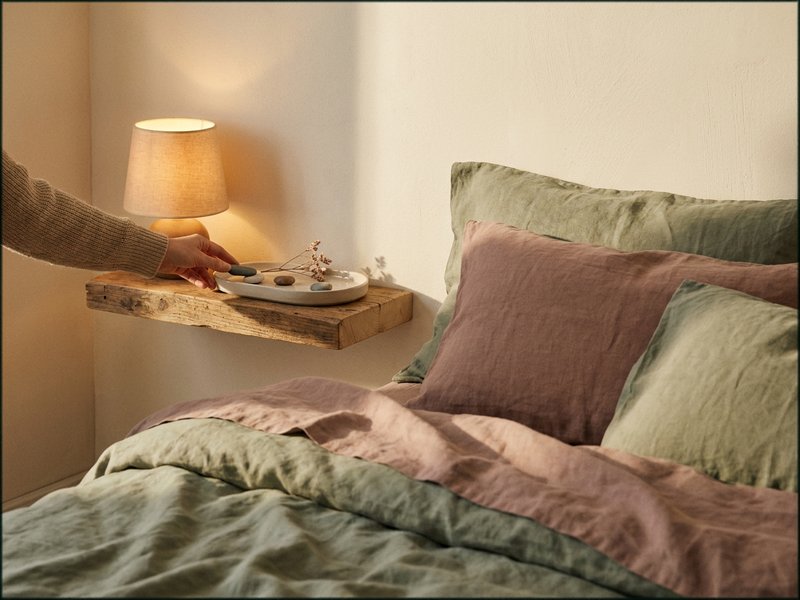
Shrink the footprint instead of the standard, using a narrow wall shelf or an over the bed tray where a full nightstand will not fit. The 5 item cap still applies, just spread across less surface.
Does sharing a bed change any of this? Mostly it changes whose 5 items sit where. Two narrow floating shelves, one per side, keep the negotiation simple: your objects stay on your shelf, and a shared charger cable is the only thing that crosses the middle. A single small shelf 6 inches deep still holds a lamp, a tray, and one book, which covers most of what actually gets used most nights.
How Do You Keep It From Sliding Back Into a Pile?
Run a 2 minute reset once a week rather than waiting for the pile to feel big enough to deserve an hour. A small, frequent reset survives a tired week. A rare, large one does not.
Pick the same moment each week, Sunday morning or the night you change the sheets, and run through 3 questions: does anything here not belong, is the tray still one shape or has it spread, and does the charger cord need re coiling. That is the whole reset. If sleep itself is still the harder half of the problem once the surface is calm, the sleep products that actually helped my ADHD brain settle covers what to try next.
The Centers for Disease Control and Prevention lists a consistent pre sleep routine among the habits most linked to falling asleep faster, and a calmer surface is one of the cheapest ways to build that consistency without changing your whole bedtime.
My small win was giving up the fight to keep my bedside completely clear and just adding one basket to hold the pile instead. I always end up with something next to me in bed, so I stopped shaming myself for it and contained it instead of chasing zero. The basket is the aesthetic now, and it is one I can actually keep up with.
Start with the light and the tray. Everything else can wait for a slower week. You’re not behind. You’re just differently wired.
Save this for later? Pin the list so it is one tap away the next time your nightstand needs a reset.
Found this helpful? Pin this guide so you can come back to it anytime.
Frequently Asked Questions
What should be on an ADHD friendly nightstand?
Cap it at 5 objects: a warm dimmable lamp, a shallow tray for daily items, a covered tumbler for water, one closed book, and a small lidded box for anything you would rather not see. Fewer visible decisions matters more than any single product choice.
How do I stop my nightstand from getting cluttered again?
Run a 2 minute reset once a week instead of waiting for a big cleanup. Check whether anything does not belong, whether the tray still reads as one shape, and whether the charger cord needs re coiling. Small and frequent survives a tired week better than a rare deep clean.
Can an aesthetic nightstand actually help with ADHD sleep?
Yes, indirectly. A calmer, low clutter surface reduces the small decisions your brain makes right before sleep, and warm light under 3000K signals evening instead of daytime. Neither replaces treatment for real sleep problems, but both lower the friction around winding down.
What if I do not have room for a full nightstand?
Use a narrow floating shelf or an over the bed tray and keep the same 5 item cap on a smaller footprint. A shelf as shallow as 6 inches still holds a lamp, a tray, and one book, which covers most of what gets used on an average night.
Is it bad to keep things in a closed nightstand drawer?
Only if you actually need to see it to remember it exists. A closed drawer works fine for things used occasionally, like spare chargers or paperwork, but daily objects tend to disappear from memory once a drawer front hides them. Keep those in an open tray instead.