
This reflects my personal experience with ADHD. What works for me may not work for everyone.
ADHD meal prep works best as a handful of small, repeatable steps done on grocery day, not a full Sunday production that burns you out by week two. Cutting vegetables and seasoning meat while you unload the grocery bags, then cooking on one sheet pan instead of five, keeps the system alive on the weeks you have zero extra energy. A single mother raising two neurodivergent kids on her own put it plainly: she still buys pre cut vegetables and frozen berries for herself, but between full time work and her kids’ needs, her own healthier routines keep slipping after only a few days. Meal prep has to survive that kind of week, not just the good ones.

ADHD meal prep survives longest when it happens in small pieces on grocery day, like chopping vegetables while unloading bags, instead of one long cooking session that depends on motivation you often do not have later. Sheet pan meals and pre portioned freezer bags cut the daily decisions down to almost nothing.

Save this for later
You will want this again. Pin it to your planning board so it is one tap away when you need it.
Pin it for laterWhy Does Meal Prep Burn People Out Instead of Helping?
Most meal prep advice assumes a three hour Sunday session where you cook five separate dishes from scratch. That plan needs a rested, motivated version of you who has nothing else pulling at her attention. But what happens on the Sundays when that version of you does not show up? The whole system collapses, and worse, it usually collapses with a fridge full of prepped food that goes bad because the follow through step also depended on energy you did not have. ADHD meal prep works differently when it is built around small, low decision actions spread across the days you already have momentum, rather than one big session you have to protect.
What Is the ADHD Reason Meal Planning Feels So Hard?
The National Institute of Mental Health describes planning and follow through as executive function skills that ADHD affects directly, which is part of why deciding what to eat for the next seven days in one sitting feels disproportionately exhausting. It is not seven small decisions. It is seven decisions made back to back with no break, which drains the same limited resource all at once. Spreading those decisions across the week instead, or removing them with a repeating rotation, works with that limit instead of fighting it.
How Do You Meal Prep on Grocery Day Instead of Later?
Grocery day momentum is the mechanism behind one batch prep method shared inside ADHD community threads: instead of trusting a future version of yourself to cook from scratch later, cut up vegetables, onions, and potatoes, then season or marinate your meats while you are already unloading the bags. That way ingredients sit ready across the week instead of requiring a fresh decision every single night. What if you skip this step because you are too tired the moment groceries are put away? The same discussion pointed to a clear pattern: skipping prep on grocery day reliably meant the food got thrown away unused instead of cooked, so the five extra minutes right then is what actually determines whether the groceries get eaten.

Step 1: Pick a Repeating Rotation Instead of Planning From Scratch
One mother made a Pinterest board of the 5 meals her family reliably eats and shops from that board instead of trying to plan something new from scratch each week. Decision fatigue at the grocery store drops sharply once you are choosing between 5 known options instead of inventing a menu on the spot. What if 5 meals feels boring after a month? Add one new option every few weeks instead of replacing the whole list, so the rotation grows slowly instead of resetting to zero. Pick 4 to 6 meals you already know work, write them down somewhere you will actually see again, and let the rotation carry most weeks. New recipes can stay a weekend hobby instead of a weekly requirement.
Step 2: Cook on One Sheet Pan Instead of Five Separate Dishes
The same grocery day method pairs the vegetable and meat prep with sheet pan cooking, which cuts the cleanup step down to a single pan instead of a sink full of pots. Toss your pre cut vegetables and marinated protein onto one lined pan, roast, and portion straight from the pan into containers. A large rimmed sheet pan that actually fits your oven makes this faster than the flimsy one you already own, and it is one of the lowest cost upgrades on this list.
Step 3: Batch and Freeze One Protein at a Time
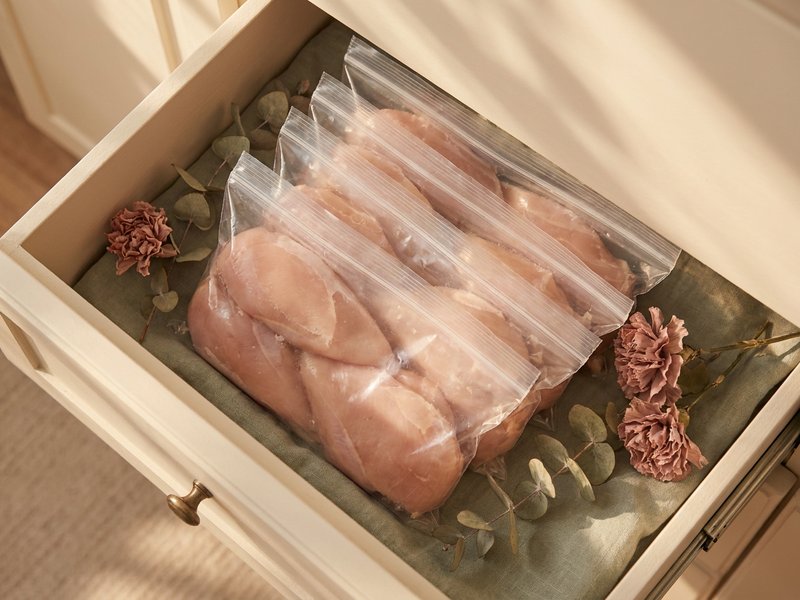
One mother described batch seasoning all 8 chicken breasts at once, freezing them in a single layer, then bagging them together so she could pull out one at a time to thaw. The single layer freeze matters: it stops the whole batch turning into one solid block you have to thaw all at once. What if you only have room for one bag of protein in the freezer at a time? Rotate a single protein each week instead of stocking several, since one thawed portion still beats zero every time. Do the same with any protein you already buy regularly, and you get the effect of meal prep without needing to also decide what to cook with it every time.
What If You Skip a Week Entirely?
Skip it. A missed prep week is not proof the system failed, it is one bad week inside a system built to survive bad weeks. Restart at the next grocery trip instead of waiting for a symbolic fresh start on a Monday or the first of the month. The mother who batch freezes chicken still calls food the one area of her life that stays touch and go no matter what she tries, despite medication, and her system still works most weeks. It does not have to be flawless to be worth keeping.
Step 4: Build in an External Reminder for Meal Times
Standard advice assumes a set lunch window is its own reminder. One woman described the opposite: her work cafeteria served lunch from 11:30 to 1:30, yet hunger arriving before that window meant the whole thing got mentally snoozed, and hyperfocus meant the snooze was never cancelled. But what actually fixed it for her? Not a personal willpower fix. Colleagues who checked in during that two hour window, externalizing the reminder she could not reliably generate on her own. A phone alarm labeled with the meal, not just a generic chime, does the same job when there is no coworker nearby to ask. The CDC’s overview of ADHD lists trouble with time awareness as a common everyday challenge, which is exactly why an external cue works better here than trying to remember on your own. This is the same reminder gap covered in more depth in this guide to eating regularly when ADHD makes you forget, which goes further into why hunger cues get missed in the first place.
Step 5: Keep One Backup Meal That Requires No Decisions
Every rotation needs one meal that requires zero thinking for the nights prep simply did not happen: frozen dumplings, a can of soup, eggs on toast. Does keeping a backup meal mean the rotation failed? No. It is the difference between eating something and ordering takeout you cannot afford, or eating nothing at all. Keep the ingredients stocked at all times so the backup meal is never the thing you also have to remember to buy.

Save this guide so you can come back to it before your next grocery trip.
A mother of two toddlers, diagnosed with ADHD at 37, said medication took away the constant background noise of thinking about food all day, and six months into treatment she was down about 12 pounds and lighter than she had been in two years. Stepping on the scale and seeing that felt like the first real proof something had actually changed. Your version of that proof could just be a fridge with real food in it on a Thursday. That counts too. You’re not behind. You’re just differently wired.
Found this helpful? Pin this guide so you can come back to it anytime.
Frequently Asked Questions
How do I meal prep with ADHD without getting overwhelmed?
Break meal prep into small pieces on grocery day instead of one long Sunday session. Chop vegetables and season meat while unloading bags, cook on one sheet pan, and pick a rotation of 4 to 6 known meals instead of planning something new every week.
What is the easiest ADHD meal prep method?
Sheet pan meals paired with grocery day prep are one of the lowest effort methods: cut vegetables and marinate protein while putting groceries away, then roast everything on one pan later in the week. It cuts both decisions and cleanup to almost nothing.
Why do I keep failing at meal prep even when I want to do it?
Most meal prep plans assume a long, motivated cooking session, which asks for exactly the executive function ADHD makes hardest to access consistently. Smaller, grocery day prep and a repeating meal rotation remove most of the planning step that causes the burnout in the first place.
What are cheap ADHD meal prep ideas?
Batch freezing one protein in single layer portions, cooking on a sheet pan you already own, and picking a rotation of meals you already buy for regularly are all free or nearly free. A phone alarm labeled with the meal name is one of the cheapest reminder fixes available.
Is it normal to forget to eat with ADHD?
Yes, forgetting to eat or losing track of meal windows is a common ADHD pattern tied to time blindness and hyperfocus, not carelessness. Externalizing the reminder, through an alarm, a labeled window, or another person checking in, tends to work better than trying to remember on your own.